Symmetry

© Leandra Rieger
The human eye loves finding patterns, and symmetry can be particularly satisfying, like slotting in the last piece of a jigsaw puzzle.
As mentioned above, centering your subject can be one means of introducing a sense of symmetry to a scene, dividing the frame vertically down the middle so that a pattern or shape is mirrored on either side.
Manmade structures often lend themselves well to creating symmetry, and architects have been using it for centuries to give a sense of stability, refinement, and balance.
Symmetry can be found in nature also, perhaps with small imperfections, such as a leaf that curves very slightly to one side at its tip.
Despite this, as long as the symmetry is strongly suggested, it can inspire a sense of tranquillity and completion in the viewer.
Dynamic Symmetry
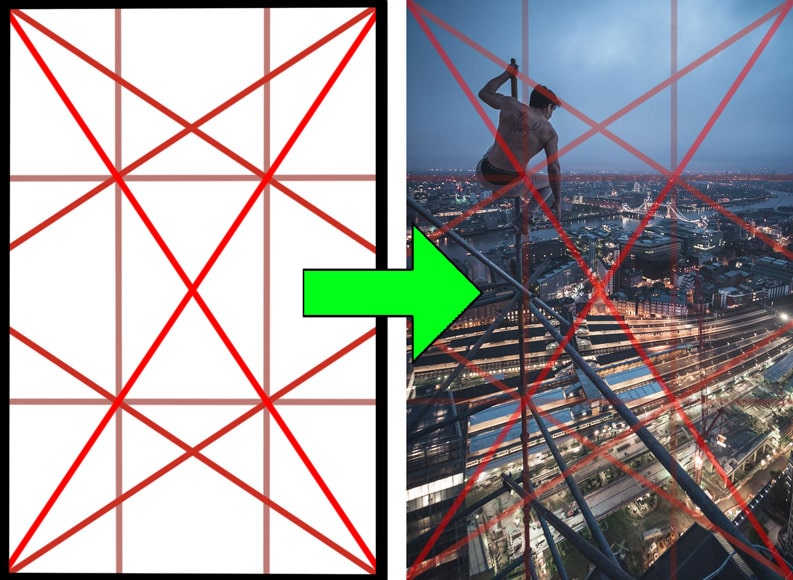
We usually think that the word symmetry means a line that divides something into two mirrored parts, or perhaps some sort of repeating pattern as a result of other reflections or rotations.
However, symmetry can also mean a beauty that comes from having balanced proportions, and it’s from this understanding that we get the term dynamic symmetry.
It stems from an understanding of proportions that can be found in nature and has its roots in the golden ratio (also known as phi and sometimes written as φ) which has influenced our understanding of beauty and balance for centuries.
The golden ratio in photography makes pictures more attractive and alluring, possibly since the balance represents proportions in nature.
It’s said that one of the most famous photographers of all time, Henri Cartier Bresson — originally a painter — used dynamic symmetry extensively in his work.
Just as the rule of thirds gives you means of dividing your frame, dynamic symmetry draws lines which can help as a guide for your composition, perhaps by finding ways to imitate these lines in your scene, or by placing certain subjects or points of interest where these lines intersect.
The foundation of dynamic symmetry is a pair of diagonal lines that run from opposite corners of your rectangular frame. You then draw another line from a corner that crosses the other diagonal line at precisely 90 degrees.
This is interesting mathematically as, whatever the portions of your rectangle, the same ratios will emerge in how these lines intersect.
You can then add additional lines that connect these intersections, creating vertical and horizontal lines that, by no coincidence, resemble the rule of thirds.
You can almost think of dynamic symmetry as being a more sophisticated and mathematically satisfying version of the rule of thirds.
While some photographers might use these lines to plan a shot — perhaps working in a studio or creating a still life — it’s more likely that you will find that you can apply these lines to photographs you’ve already taken. You can then slowly absorb how these images were effective in terms of their composition.
Dynamic symmetry can be effective because our eyes like to find certain patterns in what we see, giving us a subconscious sense of satisfaction when we encounter them.